Precision Resin Printing: Materials, Techniques, and Performance Tips


Introduction
Precision resin printing is one of the most advanced methods in additive manufacturing, delivering exceptional detail, smooth surface finishes, and high dimensional accuracy. Whether you are producing miniatures, dental models, engineering components, or intricate prototypes, mastering precision resin printing is essential for achieving consistent and high-quality results.
Unlike filament-based printing, resin printing uses photopolymerization, where liquid resin is cured layer by layer using UV light. This process enables extremely fine details that are difficult to achieve with traditional FDM printers. However, to fully benefit from precision resin printing, you need to understand materials, settings, and workflow optimization.
Understanding Resin Materials
Selecting the correct material is the foundation of precision resin printing. Different resins are designed for different applications, and choosing the wrong one can lead to poor results.
Common Types of 3D Printing Resin
- Standard Resin
Ideal for high-detail models and visual prototypes - ABS-like Resin
Stronger and more impact-resistant for functional parts - Tough Resin
Designed for engineering applications requiring durability - Flexible Resin
Suitable for parts that need elasticity and bending - Specialty Resins
Includes dental, castable, and high-temperature resins
Understanding these options helps you select the best material for precision resin printing based on your specific needs.
Key Factors When Choosing Resin
To achieve optimal results in precision resin printing, consider the following:
- Printability and ease of use
- Strength and durability
- Temperature resistance
- Surface finish quality
- Post-processing requirements
Each of these factors directly impacts the final output and overall performance of your print.
Essential Printing Settings
Correct settings are critical in precision resin printing. Even small adjustments can significantly affect quality.
Important Parameters
- Layer Height
Lower values (0.02–0.05 mm) improve detail but increase print time - Exposure Time
Must be calibrated for each resin to avoid under- or over-curing - Lift Speed and Distance
Affects print stability and reduces failure risks
Fine-tuning these settings ensures better consistency and helps you master precision resin printing.
Model Orientation and Supports
Orientation and support placement are often overlooked but are crucial for success in precision resin printing.
Best Practices
- Angle models to reduce suction force
- Avoid large flat surfaces parallel to the build plate
- Use minimal but strategic supports
- Place supports in less visible areas
Proper orientation improves surface quality and reduces post-processing work.
Post-Processing Techniques
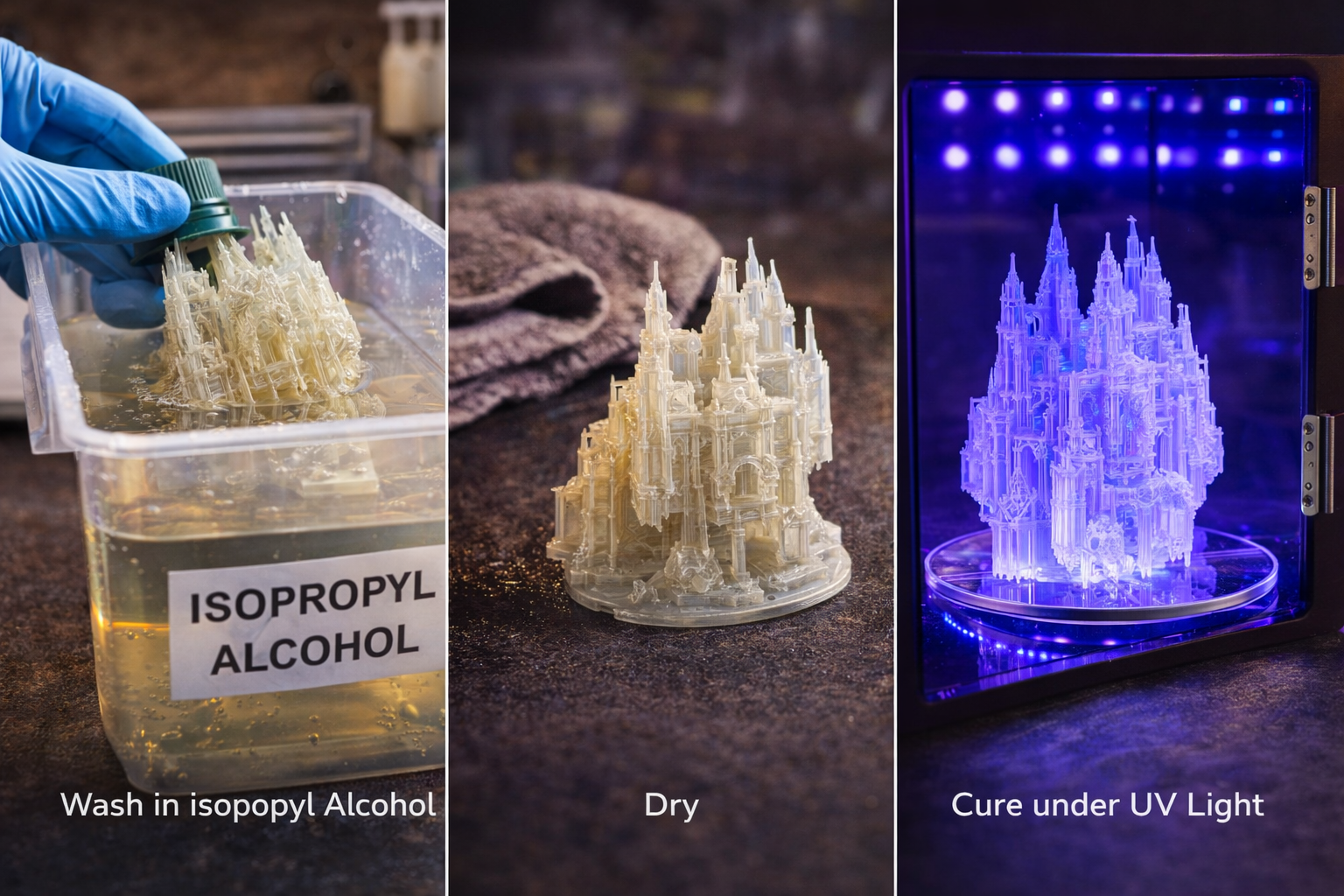
Post-processing is an essential step in precision resin printing and directly affects the final result.
Standard Workflow
- Wash prints in isopropyl alcohol to remove uncured resin
- Allow the model to dry completely
- Cure under UV light for full strength
Correct post-processing enhances durability, improves surface finish, and ensures long-term stability.
Environmental Considerations
Maintaining the right environment is key to consistent precision resin printing.
- Ideal temperature: 20–25°C
- Avoid high humidity
- Store resin in sealed containers
- Keep the printer clean and dust-free
Environmental control reduces failures and improves print reliability.
Common Issues and How to Fix Them
Even experienced users encounter problems in precision resin printing. Understanding common issues helps you troubleshoot effectively.
Typical Problems
- Layer separation → Increase exposure time
- Print not sticking → Re-level build plate
- Surface defects → Adjust orientation and supports
- Over-curing → Reduce exposure time
Systematic adjustments will help you consistently improve your results.

Performance Optimization Tips
To take your precision resin printing to the next level, follow these expert tips:
- Calibrate your printer regularly
- Use high-quality resin
- Replace worn FEP films
- Optimize support structures
- Test small models before large prints
These practices ensure reliability and high performance across all projects.
Applications of Precision Resin Printing
Precision resin printing is widely used across industries due to its accuracy and detail.
- Dental and medical models
- Jewellery design and casting
- Engineering prototypes
- Miniatures and figurines
- Product design and testing
Its versatility makes it a powerful tool for both professionals and hobbyists.
Conclusion
Precision resin printing offers unmatched detail and quality when done correctly. By understanding materials, optimizing settings, and refining your workflow, you can achieve consistent and professional results. PLA may dominate simplicity in filament printing, but in resin printing, material choice and process control define success. By focusing on your application, printer setup, and material properties, you can fully master precision resin printing and produce outstanding results every time.
For expert advice, high-quality materials, and tailored recommendations, contact our team today and take your precision resin printing to the next level.