PLA, PETG, or ABS? Choose the right filament for 3D printing?


Introduction
Choosing the correct material is one of the most critical decisions in additive manufacturing. Many beginners and even experienced users struggle to choose the right filament for 3D printing, especially when deciding between PLA, PETG, and ABS. Each material has its own strengths, weaknesses, and ideal applications.
In this guide, you will learn how to choose the right filament for 3D printing based on performance, durability, ease of use, and real-world applications. Whether you’re printing prototypes, functional parts, or decorative models, understanding these materials will help you achieve better results.
Understanding the Basics of 3D Printing Filaments
Before you choose the right filament for 3D printing, it’s essential to understand what these materials are and how they behave during printing. Filaments are thermoplastic materials that melt when heated and solidify when cooled. The three most common materials—PLA, PETG, and ABS—cover a wide range of use cases, from simple prints to industrial applications.
To choose the right filament for 3D printing, you need to evaluate factors such as:
- Printability
- Strength and durability
- Temperature resistance
- Surface finish
- Environmental impact

PLA: The Most User-Friendly Filament
What is PLA?
PLA (Polylactic Acid) is a biodegradable thermoplastic made from renewable resources like corn starch. It is widely considered the easiest material to use. If your goal is to choose the right filament for 3D printing as a beginner, PLA is usually the best starting point.
Advantages of PLA
- Easy to print with minimal warping
- Low printing temperature (180–220°C)
- Smooth surface finish
- Environmentally friendly
PLA is ideal when you want to choose the right filament for 3D printing for visual models, prototypes, or educational purposes.
Limitations of PLA
- Low heat resistance
- Brittle compared to other materials
- Not suitable for mechanical stress
PLA is not always the best option when you need to choose the right filament for 3D printing for functional or load-bearing parts.
PETG: The Perfect Balance
What is PETG?
PETG (Polyethylene Terephthalate Glycol) combines the ease of PLA with the strength of ABS. It is a popular choice for users who want more durability without sacrificing printability. Many professionals choose the right filament for 3D printing by selecting PETG for versatile applications.
Advantages of PETG
- Strong and impact-resistant
- Good layer adhesion
- Moisture and chemical resistance
- Food-safe (in some grades)
PETG is excellent if you want to choose the right filament for 3D printing for functional parts, containers, or mechanical components.
Limitations of PETG
- Stringing issues if not tuned properly
- Slightly harder to print than PLA
- Can be too flexible for some applications
Still, PETG remains a top choice when users want to choose the right filament for 3D printing with balanced performance.
ABS: Strength and Heat Resistance
What is ABS?
ABS (Acrylonitrile Butadiene Styrene) is a durable thermoplastic used in automotive and industrial applications.
If your priority is strength, you will likely choose the right filament for 3D printing by considering ABS.
Advantages of ABS
- High strength and toughness
- Heat resistance (up to ~100°C)
- Post-processing friendly (sanding, acetone smoothing)
ABS is ideal when you need to choose the right filament for 3D printing for engineering parts or high-temperature environments.
Limitations of ABS
- Warping and cracking
- Requires heated bed and enclosure
- Emits fumes during printing
ABS is not recommended for beginners trying to choose the right filament without proper setup.
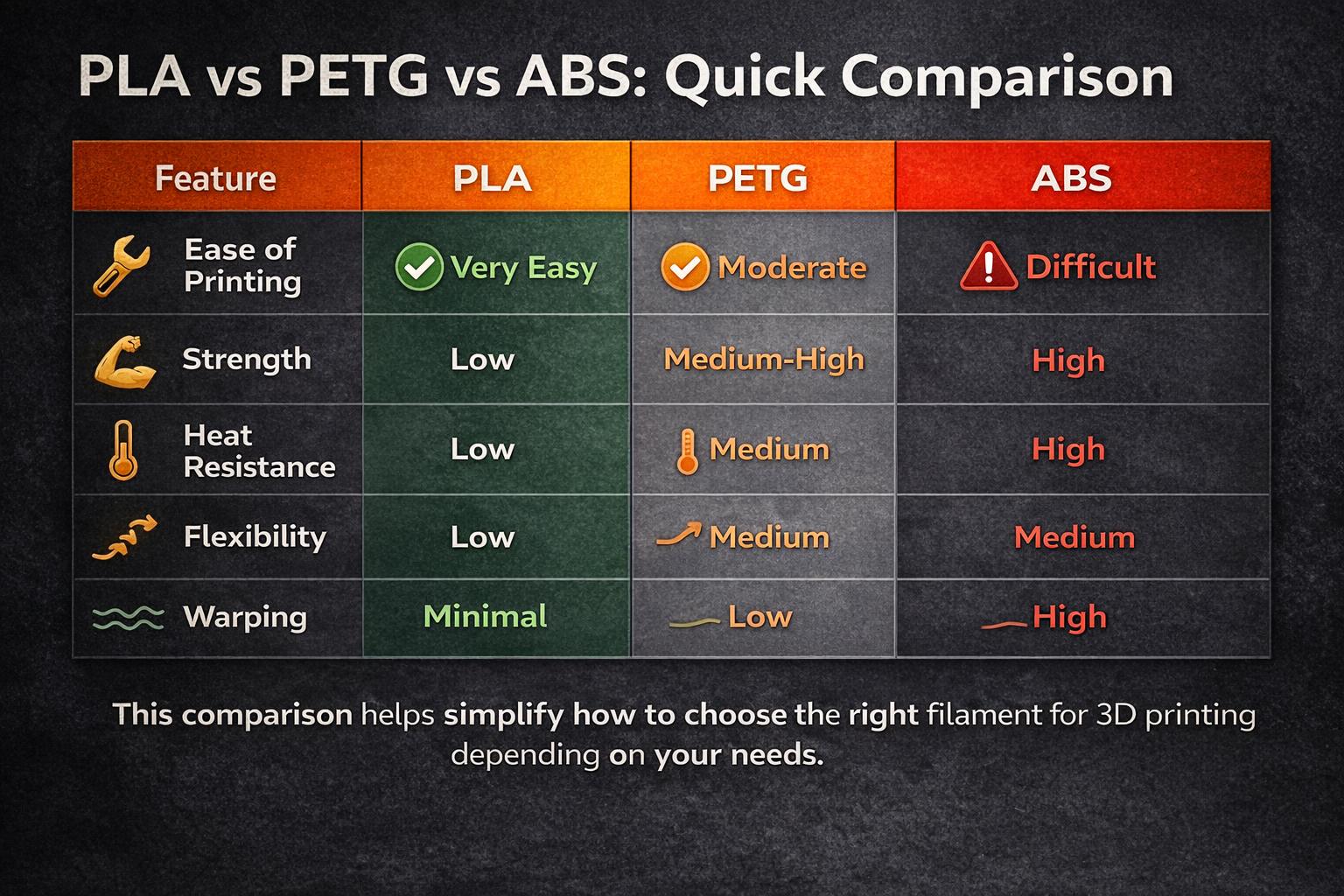
PLA vs PETG vs ABS: Quick Comparison
| Feature | PLA | PETG | ABS |
|---|---|---|---|
| Ease of Printing | Very Easy | Moderate | Difficult |
| Strength | Low | Medium-High | High |
| Heat Resistance | Low | Medium | High |
| Flexibility | Low | Medium | Medium |
| Warping | Minimal | Low | High |
This comparison helps simplify how to choose the right filament for 3D printing depending on your needs.
How to Choose the Right Filament for Your Application
To choose the right filament for 3D printing, consider the following use cases:
1. Prototyping and Visual Models
Choose PLA
It is the easiest and fastest way to produce clean-looking models.
2. Functional Parts
Choose PETG
It provides strength, durability, and reliability.
3. Engineering Applications
Choose ABS
Best for high-performance and heat-resistant parts.
Understanding your application is key to choose the right filament for 3D printing effectively.
Environmental and Practical Considerations
When you choose the right filament for 3D printing, also consider:
- Ventilation requirements (ABS needs airflow)
- Storage (PETG and ABS absorb moisture)
- Sustainability (PLA is biodegradable)
These factors can significantly influence how you choose the right filament for 3D printing in real-world scenarios.
Common Mistakes When Choosing Filament
Many users fail to choose the right filament for 3D printing because they:
- Focus only on price
- Ignore printer capabilities
- Skip proper calibration
- Choose advanced materials too early
Avoiding these mistakes ensures better results and helps you consistently choose the right filament.
Expert Tips for Better Results
- Start with PLA before moving to PETG or ABS
- Use proper bed adhesion techniques
- Store filaments in dry conditions
- Optimize temperature and speed settings
These tips will help you not only print better but also choose the right filament for 3D printing with confidence.
Conclusion
Selecting the right material can make or break your print quality. Whether you are a beginner or a professional, learning how to choose the right filament for 3D printing is essential for achieving consistent and high-quality results. PLA is perfect for simplicity, PETG offers versatility, and ABS delivers strength. By understanding their differences, you can confidently choose the right filament for any project. If you focus on your application, printer setup, and material properties, you will always be able to choose the right filament for 3D printing and get the best possible outcome from your 3D printer.