Educational Models
Engaging prints for learning, experimentation, and STEM education
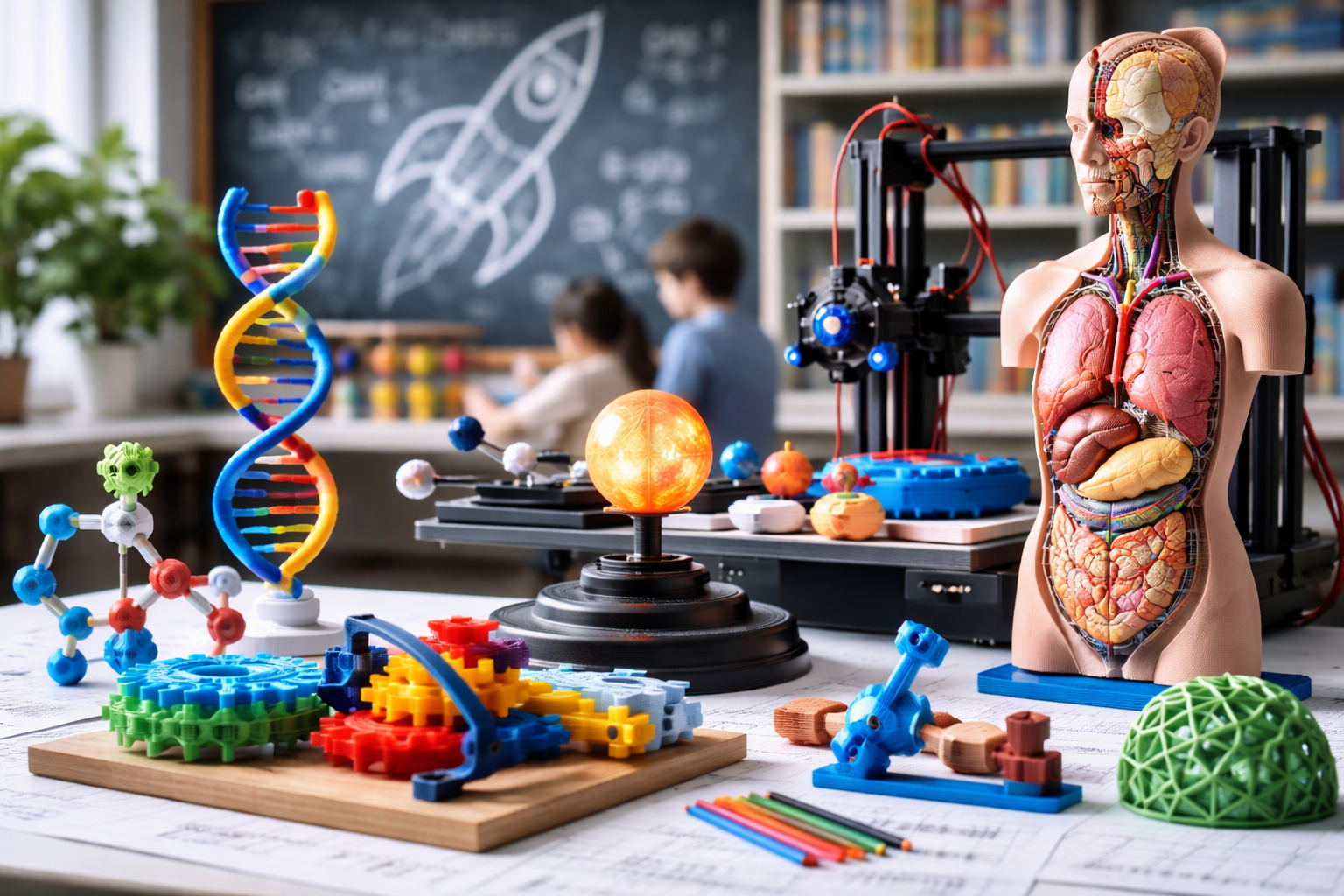
Educational models have become an essential part of modern learning environments, especially with the rise of additive manufacturing technologies. 3D printing educational models allows abstract concepts to be transformed into tangible objects, making it easier for students to understand complex ideas through direct interaction. Instead of relying only on textbooks or digital simulations, learners can physically explore structures, mechanisms, and systems, which significantly improves comprehension and retention.
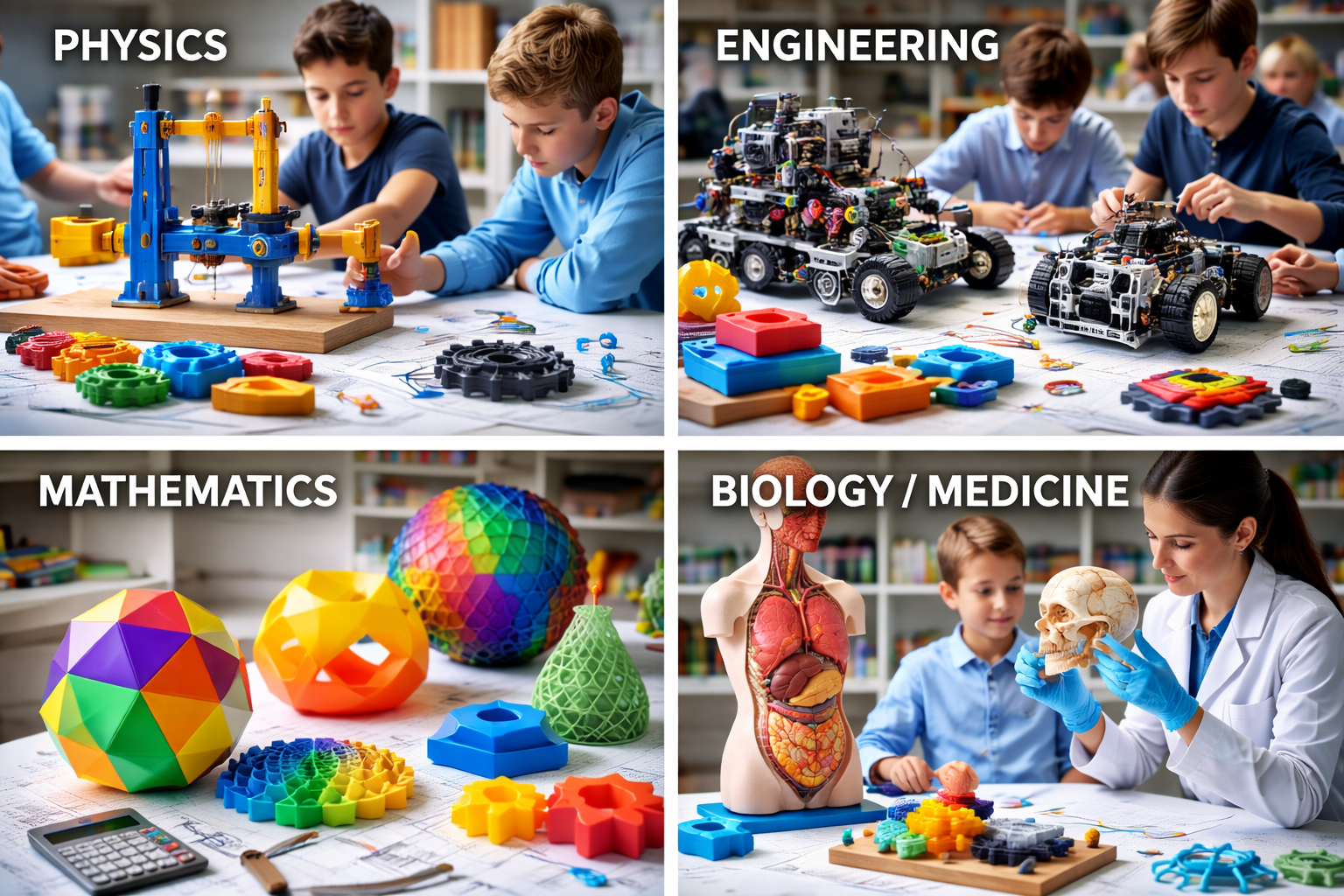
3D printing educational models is particularly valuable in STEM education, where visualizing and testing concepts is critical. Subjects such as physics, engineering, mathematics, and biology often involve ideas that are difficult to grasp without practical demonstration. By using 3D printing educational models, students can see how forces act on structures, how mechanical components interact, or how biological systems are organized. This hands on approach enhances both engagement and understanding.
The Role of 3D Printing Educational Models in Learning
One of the main advantages of 3D printing educational models is the ability to bridge the gap between theory and practice. In traditional education, students often learn formulas and concepts without seeing how they apply in real life. With physical models, these concepts become more accessible and meaningful.
For example, in engineering education, students can study stress distribution or structural behaviour using printed models. In mathematics, geometric shapes and spatial relationships can be explored in three dimensions. In biology, anatomical models help students visualize complex structures that are otherwise difficult to understand. 3D printing educational models also encourages active learning. Instead of passively receiving information, students engage with the material, ask questions, and explore different possibilities. This approach leads to deeper understanding and improved problem solving skills.
Materials for Educational Models
Choosing the right material is important when producing 3D printing educational models. Since these models are often handled frequently, materials must be durable, safe, and easy to print.
- PLA is one of the most commonly used materials for educational models. It is easy to work with, provides good surface quality, and is suitable for a wide range of applications. It is also safe for classroom environments, making it ideal for schools and universities.
- PLA Plus offers additional strength and durability compared to standard PLA. It is useful for models that require repeated use or mechanical interaction.
- PETG can be used for more robust educational models that need higher impact resistance. It is suitable for functional demonstrations and moving parts.
At Additron, materials are developed to provide consistent performance, ensuring that 3D printing educational models can be produced reliably without frequent print failures. This reliability is especially important in educational settings where time and resources are limited.
Applications in STEM Education
3D printing educational models are widely used across different STEM disciplines.
- In physics, models are used to demonstrate concepts such as force, motion, and energy. Students can observe how structures respond to loads or how mechanisms transfer motion.
- In engineering, educational models are used to teach design principles, manufacturing processes, and system integration. Students can create and test their own designs, gaining practical experience.
- In mathematics, geometric models help visualize shapes, angles, and spatial relationships. This is particularly useful for understanding complex topics such as calculus or vector geometry.
- In biology and medicine, anatomical models allow students to study the human body in detail. These models provide a clear understanding of structures that are difficult to visualize through images alone.
3D printing educational models also support interdisciplinary learning by combining multiple subjects into a single project. For example, a robotics project may involve mechanical design, electronics, and programming, all supported by printed components.
Benefits of 3D Printing Educational Models
The use of 3D printing educational models offers several key benefits.
- Improved engagement is one of the most noticeable advantages. Students are more interested and motivated when they can interact with physical objects.
- Better understanding is achieved through hands on learning. Concepts that are difficult to explain theoretically become easier to grasp when demonstrated physically.
- Customization allows educators to create models tailored to specific lessons or learning objectives. This flexibility is not possible with standard teaching materials.
- Cost efficiency is another benefit. Once a 3D printer is available, models can be produced at a relatively low cost compared to purchasing specialized equipment.
- Rapid iteration enables continuous improvement. Models can be modified and reprinted quickly, allowing students to test different ideas and learn from their mistakes.
These benefits make 3D printing educational models a powerful tool for modern education.
Encouraging Creativity and Innovation
Beyond understanding existing concepts, 3D printing educational models also encourage creativity. Students are not limited to using predefined models; they can design their own solutions to problems. This process involves identifying a problem, creating a design, printing a model, and testing its performance. Through this cycle, students develop critical thinking, design skills, and technical knowledge.
3D printing educational models also promote innovation by allowing students to experiment with new ideas. Since prototypes can be produced quickly, students can explore multiple approaches and refine their designs based on results. This hands on experience is valuable for preparing students for real world challenges, where problem solving and innovation are essential.
Integration into the Classroom
Integrating 3D printing educational models into the classroom requires careful planning. Educators need to align models with learning objectives and ensure that students understand how to use them effectively. Simple models can be used to introduce basic concepts, while more complex projects can be used for advanced learning. Group activities can encourage collaboration, allowing students to work together on design and problem solving tasks. Teachers can also use 3D printing educational models for demonstrations, helping explain concepts during lectures. Visual and physical examples make lessons more engaging and easier to follow.
Challenges and Considerations
While 3D printing educational models offer many advantages, there are also challenges to consider.
- Printing time can be a limitation, especially when producing multiple models for a class. Proper planning is required to ensure that models are ready when needed.
- Design complexity may also be a challenge for beginners. Students may need guidance in creating printable designs and understanding design constraints.
- Material management is important to ensure consistent results. Filament should be stored properly to avoid moisture related issues that can affect print quality.
Despite these challenges, the benefits of 3D printing educational models far outweigh the limitations, especially when implemented effectively.
Why Choose Additron for Educational Models
Consistency and reliability are essential in educational environments. Materials must perform well every time to avoid disruptions during lessons. Additron materials are designed to provide stable extrusion, consistent diameter, and predictable results. This ensures that 3D printing educational models can be produced with minimal issues, allowing educators to focus on teaching rather than troubleshooting.
With high quality materials, students can achieve better results and gain confidence in their work.
Practical Tips for Educational Printing
- Start with simple models to introduce students to 3D printing.
- Use materials like PLA for ease of use and safety.
- Ensure printers are properly calibrated for consistent results.
- Encourage students to experiment with design and settings.
- Store materials in dry conditions to maintain quality.
These practices help create a smooth and effective learning experience.
Conclusion
3D printing educational models have transformed the way students learn by making education more interactive, engaging, and practical. By converting theoretical concepts into physical objects, this technology helps students understand complex ideas more effectively. From STEM education to creative projects, 3D printing educational models provide valuable opportunities for experimentation, innovation, and skill development. With the right materials, tools, and approach, educators can create a dynamic learning environment that prepares students for future challenges. Additron supports this process by providing reliable materials that ensure consistent results. As technology continues to evolve, 3D printing educational models will play an increasingly important role in shaping the future of education.